

Out on his daily constitutional, a dog in Poland unexpectedly struck gold, or rather, silver. The dog was being taken for a walk by his owner near the city of Wałbrzych in southwestern Poland when he began digging the soil to get to the bottom of the something unusual his powerful olfactory senses detected. He was rewarded by a jugful of bracteate medieval coins, which are thin, single sided, and were used as currency in the Middle Ages in northern Europe, especially in Germany, Hungary and Poland.
Kajtuś the dog was probably disappointed by the find. But his owner immediately realized the worth of Kajtuś’s discovery and alerted the Wałbrzych branch of the Lower Silesia heritage protection office, who has since issued a report . The office dispatched a team, including archaeologists from the University of Wrocław, to investigate. They have termed the discovery of the recent 13th-century medieval coin find as the first such large discovery in more than a hundred years, reports the NFP.
“The person who contacted us was out walking the dog,” Anna Nowakowska-Ciuchera, the Wałbrzych heritage protection officer is reported by the NFP to have said. “Kajtuś started digging in the earth, and that was how he reached the jug with the coins.”
Two of the silver medieval coins unearthed by the dog in Poland. ( Dolnośląski Wojewódzki Konserwator Zabytków )
A Potful of Treasured Medieval Coins Called Bracteates
The medieval bracteate coins were preserved in a damaged earthenware pot. The experts from the Lower Silesia protection office of Poland have dated these coins to the first half of the 13th century and believe that they were minted in Saxony (east Germany) or Silesia (covering the Czech Republic, Poland and a corner of southeastern Germany).
What makes the find so rare and exciting is that “finding a significant number of coins from this period is an exceptional occurrence,” the heritage protection office is reported to have stated according to the NFP. This is because as many as two to three new currencies sometimes came into circulation in a single year. And each time a new currency was issued, the old was melted to be minted anew.
While the medieval coins’ terracotta container was damaged, the coins themselves are in exceptionally good shape and the prints on them are clearly visible. Poland’s largest previous finds of bracteates have been in the Warsaw and Kraków regions. Fearing that the area of the new find will soon be overrun by amateur metal detectorists, the heritage protection office is, for the time being, keeping the exact location close to its chest. It foresees the area turning into a medievalist Mecca.
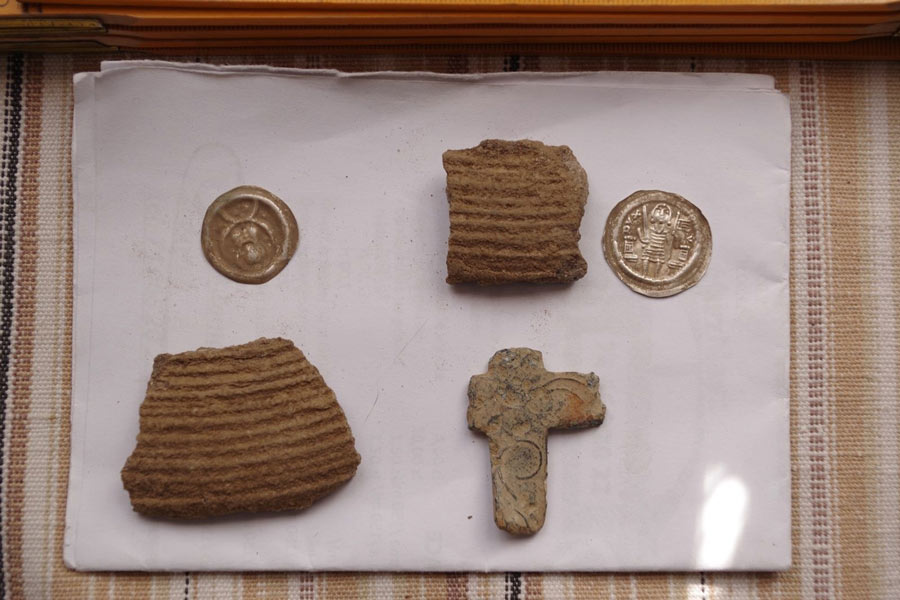
Part of the terracotta container in which the rare medieval coins and an ancient cross were found. ( Dolnośląski Wojewódzki Konserwator Zabytków )
Why Were Bracteates Minted?
The name bracteate comes from the Latin bractea, meaning a thin piece of metal. Bracteates began as a form jewelry during the European Migration Period (300-700 AD) and were often sewn into clothing. However, in the 12th-13th century bracteates were minted as currency and used across central Europe. To make them, a single die was used to strike a column of several blanks resting on a piece of leather, so that the reverse of each was the hollowed impression of the obverse.
Bracteate medieval coins were often stamped with depictions of animals, strange figures, or architectural designs. These representations make them a rich source of study of the European Middle Ages , the Lower Silesia heritage protection office stated according to the NFP.
But why were these unusual coins minted? The heritage protection office explained that it was the shortage of silver ore that led to the practice of issuing these coins. “The idea of stamping coins from a thin plate was caused by the low availability of ore – silver or, more rarely, gold, and the reserves of the mint. Kings, dukes, and bishops could mint coins.”
Once silver deposits were discovered at Kutná Hora near Prague at the beginning of the 14th century, bracteates were gradually replaced by the Prague groschen. The Prague groschen became very common throughout medieval central Europe because of the high amounts of silver used in the coin.
After the latest Polish medieval coins have been carefully examined and conservation measures taken, the entire collection will be housed in a museum. It is to be hoped that the collection will bear a tribute to Kajtuś the dog who brought this rare archaeological heritage to light. Possibly he has been appropriately rewarded by his owner with something more suited to his palate than pieces of metal!
Top image: The hoard of silver bracteate medieval coins found by a dog in Poland! Source: Dolnośląski Wojewódzki Konserwator Zabytków
By Sahir Pandey

