

Updated on April 20th, 2022 by Quinn Mohammed
It is not hard to see why Business Development Companies—or BDCs—are popular investments among income investors. Considering that the S&P 500 Index currently has an average dividend yield of just 1.3%, these high-yield stocks are very appealing by comparison.
BDCs typically offer very high dividend yields. For example, Gladstone Investment Corporation (GAIN) is a BDC with a current dividend yield of 5.5%, with occasional supplemental dividend payouts that push the yield even higher.
And, it is one of a select few stocks that pays its dividend each month, rather than each quarter. GAIN is one of 50 monthly dividend stocks.
We have compiled a full list of 50 monthly dividend stocks. You can download our full Excel spreadsheet of all monthly dividend stocks (along with metrics that matter like dividend yield and payout ratio) by clicking on the link below:
GAIN stock has a combination of a high yield and monthly payouts, which on the surface is very attractive for income investors. But of course, investors should assess the quality of GAIN’s business, its future growth potential, and the sustainability of the dividend before buying shares.
This article will discuss GAIN’s business model, and whether the high dividend yield is too good to be true.
Business Overview
GAIN is a Business Development Company that places debt and equity investments in small and medium privately-held companies, which are at an early stage of development. These companies usually have annual EBITDA in the range of $3 million to $20 million.
A rundown of GAIN’s investment process can be seen in the image below:
Source: Investor Presentation
The trust’s debt investments primarily consist of senior term loans, senior subordinated loans, and junior subordinated loans.
On the equity side, investments primarily consist of preferred or common stock, or options as a means of acquiring stock. Equity investments are usually made in anticipation of a buyout or some form of recapitalization. Investments are made in the lower-middle market segment, meaning companies that are medium-sized. GAIN intends its portfolio to have a 75%-25% split between debt and equity investments.
GAIN makes money in two ways. First, when its investments are successful, it will realize capital gains. In addition, it receives interest and dividend income from securities held.
The company aims to invest in businesses that provide stable earnings and cash flow, which GAIN can use to pay operating expenses, meet its own debt obligations, and make distributions to shareholders with residual cash flow.
The BDC reported its third quarter (for the period ending December 31st) results on February 8th. The company generated total investment income – Gladstone Investment’s revenue equivalent – of $17 million during the quarter, a decline of 4% compared to the prior year’s quarter. This missed the analyst consensus estimate by $0.8 million, as analysts expected stronger top line performance.
On an adjusted basis, net investment income-per-share (NIIPS) totaled $0.26 for the fiscal third quarter, up 15% from $0.23 per share in the prior quarter. Gladstone Investment’s net asset value per share totaled $13.27 at the end of the quarter, which was flat from the end of the previous quarter.
Fiscal 2020’s NIIPS was down quite meaningfully versus 2019, due to the impact of the pandemic. It looks like the company will recover meaningfully in the current fiscal year and beyond.
Growth Prospects
GAIN’s investment strategy has been successful over the past several years. Over the last five years its profits grew by 4.3% annually, which is not a very high growth rate, but which is also not disappointing for a high-yielding investment.
Gladstone Investment makes its money via spreads between the interest rates the company pays on cash that it borrows, and the interest rates the company receives on cash that it lends – the same principle as with banks. Despite declining interest rates in the last couple years, Gladstone Investment’s weighted average interest yield has held up very well; the company generated a yield of around 13% before the pandemic.
A short-term headwind will stem from higher loan losses that will be caused by the coronavirus crisis, but we do not see this impacting profitability in the long run.
In addition, the bulk of GAIN’s debt portfolio is variable-rate, with a floor or minimum. This will help protect interest income in a rising-rate environment. Continued growth going forward will rely on the successful implementation of the investment strategy, which appears likely, given the company’s history of proven results.
We expect 3% annual NII-per-share growth over the next five years, which we believe is a reasonable estimate of future growth given all of the above factors. GAIN shareholders benefit from the company’s strong investment performance, although whether this performance would hold up in a severe recession is a different question.
Competitive Advantages & Recession Performance
GAIN also has a durable competitive advantage due to its unique expertise in the lower middle market private debt & equity segment. Lower middle market companies are broadly defined as those with between $5 million and $50 million of annual revenue.
This segment is generally too small for commercial banks to lend to, but too large for the small business representatives of retail banks to lend to. GAIN fills this gap. By putting money to work in this unloved group of private companies, GAIN can realize outsized returns compared to its larger commercial bank counterparts.
Listed below is GAIN’s net-investment-income-per-share and distribution per share both before, during and after the last recession:
- Net-investment-income-per-share 2007 – $0.67
- Net-investment-income-per-share 2008 – $0.79 (18% increase)
- Net-investment-income-per-share 2009 – $0.62 (22% decrease)
- Net-investment-income-per-share 2010 – $0.48 (23% decrease)
The company’s historical distributable net income during the Great Recession is shown below:
- Distributable-net-investment-income 2007 – $0.85
- Distributable-net-investment-income 2008 – $0.93 (9% increase)
- Distributable-net-investment-income 2009 – $0.96 (3% increase)
- Distributable-net-investment-income 2010 – $0.48 (50% decrease)
GAIN saw severe declines in net-investment-income-per-share during the last recession, though the company did return to growth by 2011. Results for this metric have varied from year to year since then.
In 2020, as the coronavirus pandemic sent the U.S. economy into recession, GAIN’s NII-per-share declined 23%, but the company was able to maintain its monthly dividend payments. The company then increased their dividend by 7% in October 2021.
Dividend Analysis
One reason why BDCs like GAIN can pay high dividends is because of a favorable tax structure. GAIN qualifies as a regulated investment company. As such, it generally is not subject to income taxes, so long as it distributes taxable income to shareholders.
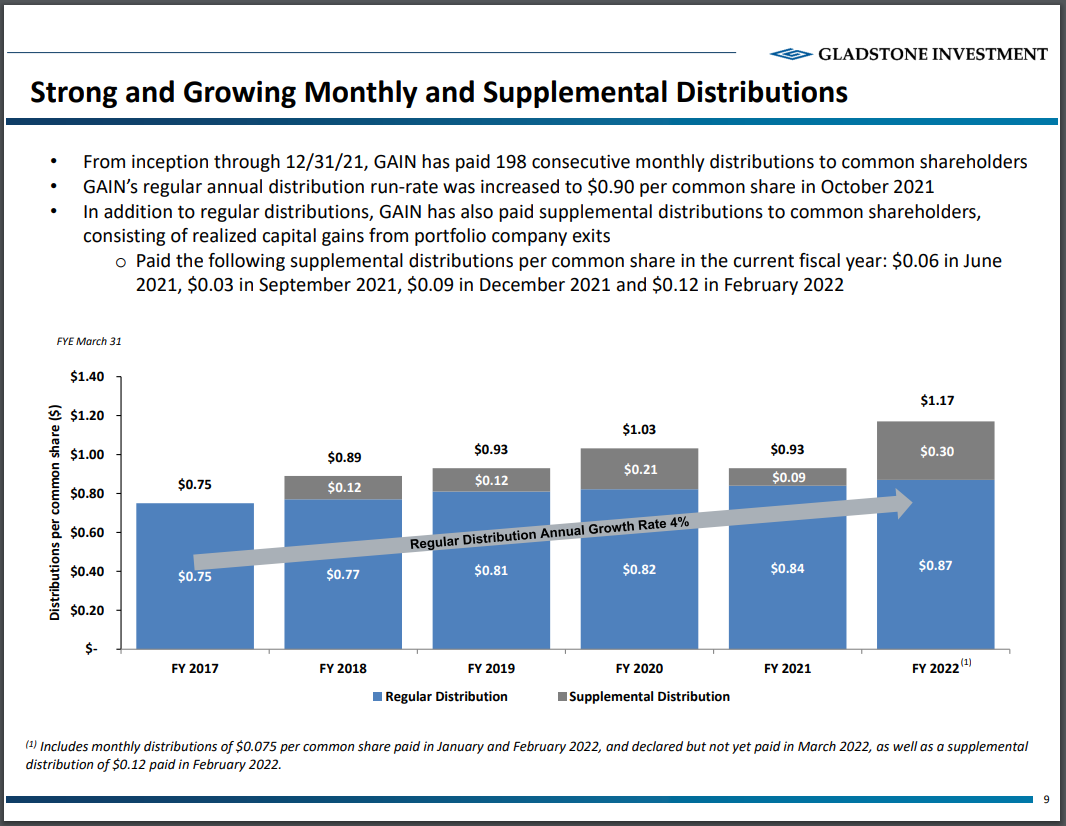
GAIN is a very attractive stock for dividend investors. It currently pays a monthly dividend of $0.075 per share. On an annualized basis, the $0.90 per-share dividend represents a 5.5% current dividend yield.
The company has a long history of consistent dividend payments to shareholders.
Source: Investor Presentation
Not only that but GAIN also provides supplemental dividends from undistributed capital gains and investment income. For example, in April 2022 the company declared a supplemental dividend payout of $0.12 per share, in addition to its regular monthly dividend, to be paid in June.
Going forward, GAIN plans to make two such supplemental dividend payments each year. Including supplemental dividends, the yield would be over 7%.
GAIN has a modest capital structure, which helps secure the dividend. Gladstone Investment’s dividend payout ratio, relative to its net investment income, has been close to or above 100% for several years over the last decade.
The company usually is more profitable than the net investment income metric suggests, due to the fact that Gladstone Investment can also generate gains from its equity investments, which are not reflected in the net investment income metric.
Final Thoughts
GAIN’s strongest competitive advantage is its investment strategy, which is to make long-term investments in high-quality businesses, with strong management teams. This has produced strong results for GAIN since inception.
Plus, shareholders can expect GAIN to make supplemental dividend payments when its investment strategy performs well. Therefore, GAIN is a high dividend stock that has appeal for investors primarily concerned with income.
Thanks for reading this article. Please send any feedback, corrections, or questions to [email protected].

